

BY STAFF REPORTER
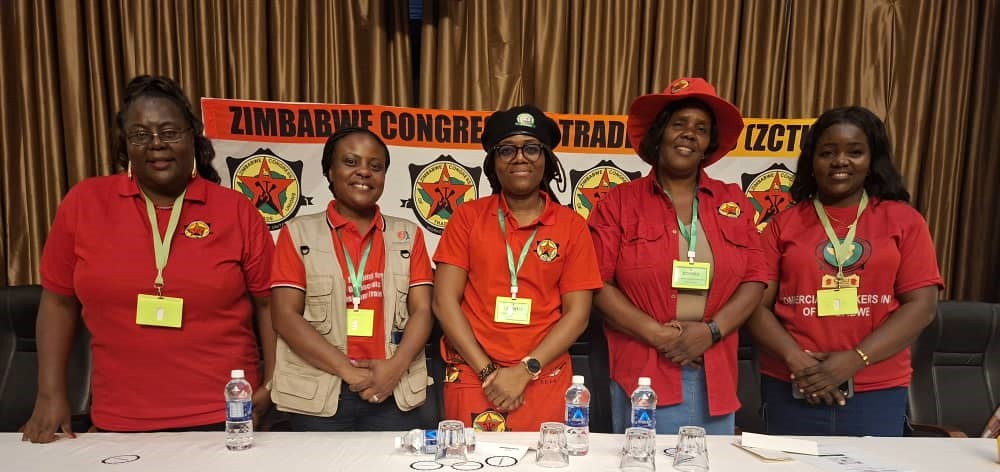
HARARE — The Zimbabwe Congress of Trade Unions (ZCTU) 8th Women’s Committee Delegate Conference has ushered in a new leadership that will steer the federation’s women’s structures for the 2026–2031 term, with delegates reaffirming the need to advance women’s leadership, economic justice and gender equality across the labour movement.
Held on 26 September 2026, the conference was held under the theme:
“Advancing Women’s Leadership, Economic Justice and Gender Equality Across all Sectors.”
The theme placed women’s leadership and economic empowerment at the centre of deliberations, reflecting the need for stronger representation of women in trade union structures and broader decision-making processes.
The conference brought together women delegates from ZCTU-affiliated unions to deliberate on issues affecting women workers, review progress made by the Women’s Committee and provide direction for the next five years.
Shungu Mupfuranhehwe of the Zimbabwe Amalgamated Railway Workers Union (ZARWU) was elected Chairperson of the ZCTU Women’s Committee for the 2026–2031 term.
She will be deputised by Susan Sapeta of the Communications Workers Union (CWU) as Vice Chairperson.
Thandiwe Mupane of the Cement, Lime and Allied Workers Union of Zimbabwe (CLAWUZ) was elected Secretary, while Elizabeth Masango of the Zimbabwe Catering Hotel and Workers Union (ZCHWU) was elected Vice Secretary.
The position of Treasurer went to Josephine Makuwa of the Commercial Workers Union of Zimbabwe (CWUZ).
The new leadership assumes office against a backdrop of persistent challenges affecting women workers, including unequal opportunities, wage disparities, insecure and precarious employment, limited representation in decision-making, workplace discrimination, gender-based violence and harassment.
The conference theme also underscored the importance of economic justice, particularly at a time when women workers are increasingly affected by economic pressures and changes in the labour market.
Delegates stressed the importance of strengthening women’s access to decent employment, social protection, skills development and economic opportunities, while ensuring that women working across different sectors are adequately represented and protected.
Women’s leadership was another major focus of the conference, with the new committee expected to strengthen the participation of women at all levels of the trade union movement.
The conference also provided an opportunity for women trade unionists to reflect on the changing world of work and its implications for women. Technological developments, changing employment patterns and the growth of informal and precarious work require trade unions to continuously adapt their organising strategies and ensure that women workers are not left behind.
The issue of gender equality remained central to the proceedings, with delegates reaffirming the need for workplaces where women enjoy equal opportunities, dignity, safety and protection from discrimination and harassment.
The new committee is expected to translate the conference resolutions into programmes and campaigns that address the practical challenges facing women workers while strengthening their voice within the labour movement.
The conference also emphasised the importance of unity among women workers, with leadership elections viewed as a constitutional process aimed at renewing and strengthening the Women’s Committee rather than creating divisions within the movement.
As the new leadership begins its five-year mandate, expectations are high for the committee to consolidate the gains made by previous women’s leadership while developing new strategies to respond to emerging challenges.
The 8th Women’s Committee Delegate Conference has therefore opened a new chapter for ZCTU women workers, with women’s leadership, economic justice and gender equality providing the central pillars for the committee’s work during the 2026–2031 term.





Leave a comment