
By Admore Marambanyika
The Zimbabwe Congress of Trade Unions (ZCTU) National Women’s Committee will hold its National Conference in Harare on September 26, with delegates expected to elect a new leadership while confronting some of the most pressing challenges facing women workers in Zimbabwe.
The conference will be held under the theme, “Advancing Women’s Leadership, Economic Justice and Gender Equality Across All Sectors.”
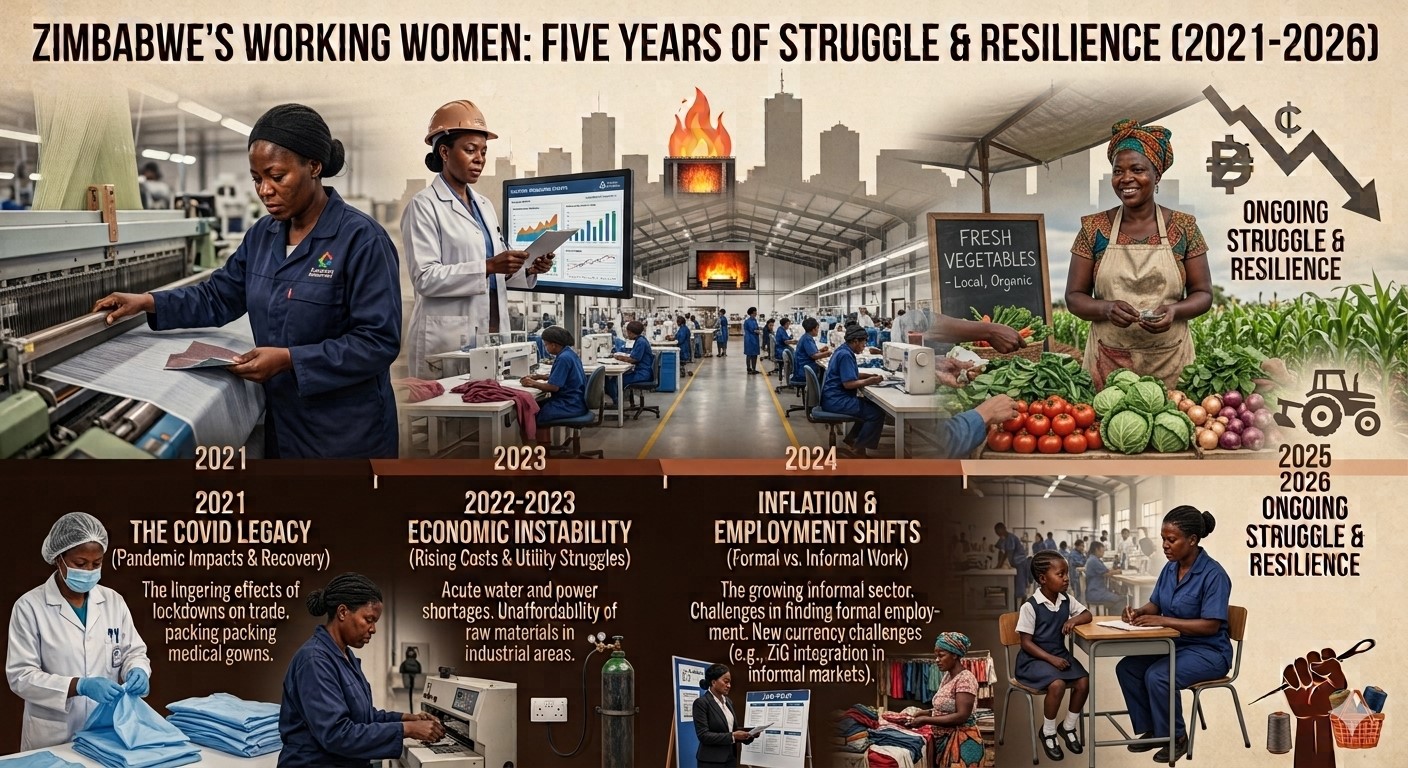
While the leadership elections are expected to dominate proceedings, the conference comes at a critical time for the labour movement as women increasingly find themselves working in informal, precarious and emerging forms of employment.
The conference is therefore expected to go beyond the election of office bearers and consider how the trade union movement can remain relevant to women workers in a rapidly changing economy.
Delegates will elect a five-member executive comprising the chairperson, vice chairperson, secretary, vice secretary and treasurer. Each affiliate union will subsequently second a councillor to form the broader executive committee.
Outgoing chairperson Shungu Mupfuranhewe of ZARWU has expressed interest in retaining her position.
Other candidates who have expressed interest include Thandiwe Mupani of CLAWUZ for secretary, Josephine Makuwa of CWUZ for treasurer, Susan Sapeta of CWU for vice secretary and Elizabeth Masango of ZUCHWU for vice chairperson.
The final list of candidates is expected to be known on Friday after the ZCTU Credentials Committee meets to verify nominations against the constitutional provisions governing the elections.
However, beyond the contest for positions, the conference faces a much broader question: how can the labour movement organise and protect women workers in an economy where traditional employment is increasingly giving way to informal, casual, self-employed and digital work?
Informal employment remains one of the major challenges confronting women workers. ILO research cited in the conference discussion estimates informal employment at around 81 percent among women, compared with 79 percent among men. The Zimbabwe Gender Commission has also highlighted the significant role played by women in the informal and rural economy, particularly in trading, agriculture and micro-enterprises.
For trade unions, the development presents a major organising challenge. Women selling goods in markets, engaging in cross-border trade, working as casual employees, operating small businesses or earning income through digital platforms may not have a conventional employer or fixed workplace. Yet they face fundamental questions about income, safety, social protection, healthcare, maternity protection and protection from exploitation and harassment. The conference will therefore need to examine whether traditional trade union structures are sufficiently equipped to reach women workers operating outside conventional workplaces.
The challenge is particularly important because women cannot be fully protected by labour rights if large sections of the female workforce remain outside effective systems of collective organisation.
For women who are employed, the workplace is only one part of their economic reality. Women continue to carry a disproportionate share of unpaid care responsibilities, including childcare, cooking, cleaning and caring for older and vulnerable family members.
The Zimbabwe Gender Commission reported in 2026 that women spend an average of 25.9 hours a week on unpaid care work, compared with 6.1 hours for men. The result is that many women effectively work a double shift — one in paid employment and another in the home.
The conference is therefore expected to consider how issues such as affordable childcare, maternity protection, parental leave, breastfeeding facilities, flexible working arrangements and public services can become part of the trade union agenda. These issues are not simply family matters. They directly influence women's ability to enter employment, remain in the workplace and advance economically.
Economic justice will also require the women's movement to confront discrimination in recruitment, remuneration, promotion and access to opportunities. The Zimbabwe Gender Commission has called for equal opportunities and equal pay for work of equal value, as well as greater access for women to training, promotion and leadership opportunities.
The new ZCTU women's leadership will therefore face pressure to turn these principles into practical workplace campaigns. Women also continue to face barriers to productive resources, including finance, land, agricultural inputs, markets, technology and business development opportunities. For women working outside conventional employment, access to these resources can be as important as collective bargaining is for workers in formal employment.
Another major issue expected to occupy the conference is violence and harassment against women workers. Women can face sexual harassment, intimidation, discrimination and other forms of gender-based violence both at workplaces and in informal economic spaces.
The Zimbabwe Gender Commission reported receiving complaints relating to workplace sexual harassment in 2026 and called for stronger enforcement of workers' rights and workplaces free from violence and harassment.
The challenge for the trade union movement is to ensure that women have accessible mechanisms through which to report abuse and seek assistance without fear of retaliation. This will require trained union representatives, effective workplace policies, awareness of workers' rights and stronger enforcement mechanisms.
Perhaps one of the most significant challenges will be extending social protection beyond the formal workforce. Informal and casual workers may have no access to unemployment protection, pensions, paid maternity leave, occupational injury protection or reliable health coverage.
The conference will therefore need to consider how trade unions can campaign for inclusive and portable social protection systems that follow workers across different forms of employment. Such systems would need to respond to the realities of domestic workers, casual workers, own-account workers, informal workers and those entering digital and platform-based employment.
The changing labour market requires a corresponding change in trade union organising. The women's movement cannot rely solely on organising workers who report to a fixed workplace, receive a conventional payslip and have a clearly identifiable employer.
The new organising frontier includes markets, farms, informal businesses, domestic work, transport, cross-border trade, online work and other emerging forms of employment. This could require new membership models, community-based organising, greater use of digital platforms and stronger representation of informal workers within union structures.
The objective would be to make trade unionism relevant to where women actually work, rather than requiring workers to fit into structures designed for an earlier labour market.
The conference will also need to address the position of young women workers. Young women are entering a labour market characterised by high levels of informality, limited secure employment opportunities and rapidly changing skills requirements. They should not be viewed merely as the future leadership of the trade union movement. They are workers and unionists today.
The conference presents an opportunity to turn the theme of economic justice and gender equality into a concrete programme of action.
Among the key priorities facing the incoming executive are: Organising informal women workers, Equal pay and economic justice, Social protection, Protection from violence and harassment, Maternity, parental protection and childcare, Recognition of unpaid care work, Skills and digital inclusion , Women's economic empowerment, Climate justice and a just transition , Women's leadership at every level.
Beyond the ballot, The significance of the September 26 conference will ultimately be measured by more than the names elected to the new executive. It will be measured by whether the incoming leadership can translate the conference theme into a practical programme that improves the lives of women workers.
The grand test for the incoming executive will therefore be whether it can transform “Advancing Women’s Leadership, Economic Justice and Gender Equality Across All Sectors” from a conference theme into a sustained organising agenda that reaches women where they work, strengthens their collective voice and places their economic and social rights at the centre of Zimbabwe's labour movement.




Leave a comment