
By Jokoniah Mawopa
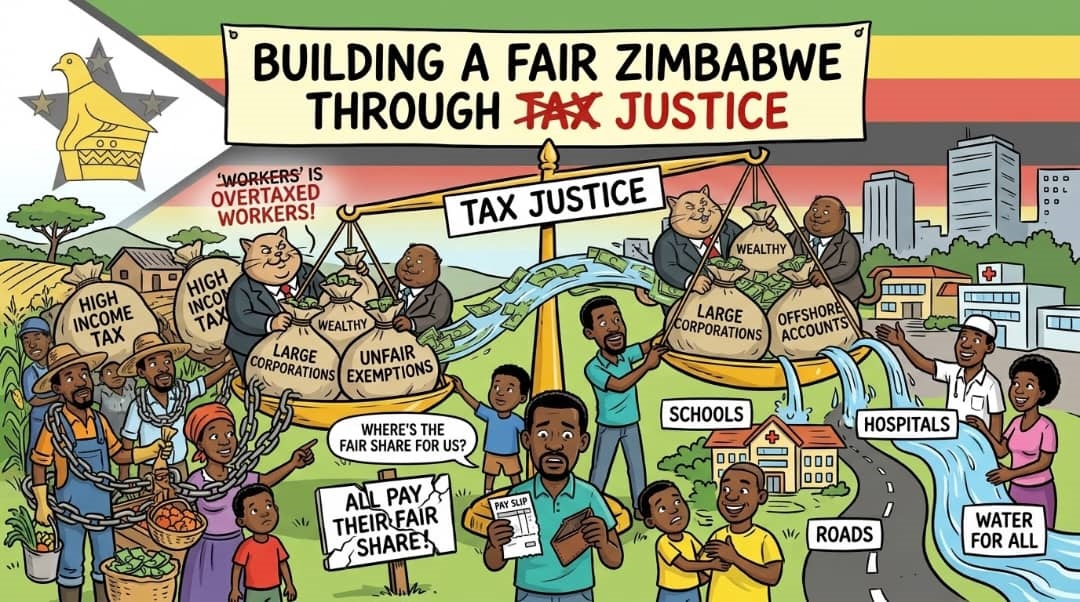
Zimbabwean workers are carrying a significant and growing tax burden. The debate on taxation, however, is often reduced to the headline Pay As You Earn (“PAYE”) rate, without considering the full range of taxes and statutory deductions that affect workers' incomes.
Zimbabwe's current PAYE system has a highest marginal income-tax rate of 40%. The 2026 ZIMRA tax tables apply progressive rates of 0%, 20%, 25%, 30%, 35% and 40%, depending on the taxable income. In addition, workers subject to PAYE pay a 3% AIDS Levy on their PAYE liability.
Workers also contribute to the National Social Security Authority (NSSA). Currently, the employee contribution is 4.5% of insurable earnings, with the applicable ceiling currently at US$700. This means that an employee earning US$700 or more contributes up to US$31.50 per month to NSSA, while the employer makes an equal contribution.
The taxation does not end when PAYE is deducted.
When workers spend their remaining income on taxable goods and services, they also encounter Value Added Tax (VAT). Since 1 January 2026, Zimbabwe's standard VAT rate is 15.5%. ZIMRA describes VAT as an indirect tax imposed on the consumption of taxable goods and services.
This creates an important distinction between the tax deducted from a worker's salary and the total fiscal burden tax burden experienced by the worker.
THE CUMULATIVE BURDEN
Consider a worker earning US$500 per month.
The worker first faces PAYE. Under the 2026 tax tables, PAYE on US$500, before the AIDS Levy, is approximately US$90. The 3% AIDS Levy adds approximately US$2.70. NSSA adds another US$22.50.
The worker therefore has approximately:
US$500 gross salary
Less:
- PAYE: approximately US$90
- AIDS Levy: approximately US$2.70
Net salary: approximately US$384.80
If the worker spends this entire amount on standard-rated goods and services, part of that expenditure represents VAT. Because VAT is included in the final consumer price, the VAT component of a VAT-inclusive US$384.80 expenditure would be approximately US$51.64, assuming all expenditure is subject to the standard rate.
The worker's remaining disposable income would therefore be approximately US$333.16.
This illustration should not be interpreted as saying that Government directly deducts 33% of every worker's salary. VAT does not apply to every item, because Zimbabwe has exempt and specially treated supplies. Rather, it demonstrates how income taxation, social-security contributions and consumption taxation interact to reduce workers' effective purchasing power.
A US$1,000 SALARY TELLS AN EVEN BIGGER STORY
Consider a worker earning US$1,000 per month.
Under the 2026 PAYE structure, the PAYE liability is approximately US$215 before the AIDS Levy. The AIDS Levy adds US$6.45 and NSSA contributes US$31.50 because the employee has reached the current US$700 insurable earnings ceiling.
The worker is therefore left with approximately US$747.05 after these payroll deductions.
If the worker spends all of this on standard-rated goods, approximately US$100.25 of the expenditure goes to VAT.
This means that, under this illustrative assumption, approximately US$353 of the original US$1,000 goes towards PAYE, AIDS Levy, NSSA and VAT.
Again, this is not an official statutory "effective tax rate". It is an illustration of the cumulative burden on a worker who has to spend virtually all of his or her disposable income.
WHY THIS MATTERS TO THE LABOUR MOVEMENT
The tax debate cannot be separated from the debate on wages and living standards.
A worker does not negotiate a wage simply to receive a number on a payslip. The real question is:
How much disposable income remains after statutory deductions and the cost of meeting basic household needs? What is the employee’s purchasing power?
A nominal wage increase can therefore fail to produce a meaningful improvement in workers' living standards when it is absorbed by taxation, inflation and increases in the prices of essential goods and services..
For labour, this makes the concept of the living wage particularly important.
The purpose of collective bargaining should not merely be to negotiate an increase in the gross wage. It should seek to protect and improve the real value of workers' incomes.
This requires bargaining strategies that consider:
- PAYE and other statutory deductions;
- NSSA contributions;
- VAT and other indirect taxes;
- food prices;
- housing costs;
- transport costs;
- education;
- healthcare;
- electricity and other utilities; and
-the overall cost of maintaining a decent standard of living.
TAXATION MUST ALSO BE FAIR
It must be recognised that taxation is necessary for Government to finance public services, infrastructure, social protection, education, healthcare and other national obligations.
As such, Workers are not opposed to taxation. The central question is tax justice.
A fair tax system should ensure that the tax burden is distributed according to the ability to pay and that the poorest and working households are not disproportionately burdened by consumption taxes.
This is particularly important where workers spend most of their income on necessities.
The taxation system must therefore be assessed not only by looking at the highest marginal PAYE rate, but also by examining who ultimately carries the burden of taxation.
TAXATION AND DECENT WORK
The International Labour Organization's decent-work framework places employment, income security, social protection and social dialogue at the centre of sustainable development.
For Zimbabwean workers, decent work must therefore include an income that provides a reasonable standard of living after taxation and unavoidable household expenditure.
The Constitution of Zimbabwe recognises workers' rights and provides the broader constitutional framework within which questions of fair labour standards, wages and social protection must be considered.
It is therefore necessary to move beyond the narrow argument that a worker's salary is adequate simply because the gross figure has increased.
What matters is the real wage.
If a worker receives a 10% wage increase but the cost of food, transport, housing and other necessities rises by more than 10%, the worker is not better off.
Similarly, if taxation and statutory deductions consume a growing proportion of the worker's income, the nominal wage increase may not translate into improved living standards.
THE WAY FORWARD
Zimbabwe needs a broader national dialogue on tax justice, wages and the cost of living.
Such dialogue should involve Government, organised labour and employers through the institutions of social dialogue.
The labour movement should advocate for:
1. A tax system that protects low- and middle-income workers.
2. Regular review of PAYE thresholds to ensure that wage adjustments caused by inflation do not automatically push workers into higher tax brackets without corresponding improvements in real income.
3. Greater protection for basic necessities from excessive consumption taxation.
4. Living-wage-oriented collective bargaining, rather than negotiations based solely on percentage increases.
5. Transparent assessment of the total tax burden on workers, including direct and indirect taxation.
6. Stronger social protection, ensuring that statutory contributions such as NSSA translate into meaningful protection in retirement, disability and other qualifying circumstances.
7. Evidence-based wage negotiations, using the cost of living, household expenditure, productivity, national income and the distribution of economic growth.
8. Progressive taxation, ensuring that those with greater capacity to pay contribute fairly to national development.
CONCLUSION
Zimbabwean workers should not be described simply as taxpayers who contribute PAYE to the fiscus.
They are also consumers who pay VAT, employees who contribute to social-security schemes and citizens who contribute to the economy through their labour.
The important policy question is therefore not simply:
"What is Zimbabwe's PAYE rate?"
The more important question is:
"What proportion of a worker's income is ultimately absorbed by taxation and statutory contributions, and what purchasing power remains to support a decent life?"
Zimbabwe's 40% maximum marginal PAYE rate, 3% AIDS Levy on PAYE, employee NSSA contribution and 15.5% standard VAT demonstrate why the cumulative burden deserves serious attention.
For the labour movement, this is not merely an accounting issue. It is an issue of wages, living standards, social justice and decent work.
Workers create wealth through their labour. They must therefore have sufficient real income to live with dignity after meeting their legitimate tax and social-security obligations.
Taxation must finance national development without undermining workers' ability to live decently. A fair tax system, living wages and effective social protection must form part of Zimbabwe's social-justice agenda.
What might be mentioned is the policy of removing zero rated goods. ZIMRA published that there has been a drive towards this.
Tax burden might be more direct.
NSSA is fully deductible, meaning deduct first from salary to get PAYE.
Effective tax rate is not statutory. Your calculation is actually an effective tax rate as per your calculation.
On the flip side workers can look at public expenditure, and advocate responsible expenditure.



Leave a comment